


Latest HSE Stats: Non-Fatal Workplace Injuries in the UK
16/01/2026
Every year, hundreds of thousands of people in the UK are injured simply by doing their jobs. Fatal and non-fatal workplace injuries affect workers across every region and industry.
The latest Health and Safety Executive (HSE) statistics paint a clear picture of the scale of the issue. From slips to falls, non-fatal incidents continue to disrupt lives, reduce productivity and place a significant financial burden on employers and the wider economy.
Beyond the immediate harm to workers, the long-term impact is substantial. Millions of working days are lost each year due to work-related injury and ill health, while the financial cost of unsafe working conditions runs into the tens of billions of pounds.
We take a look at the latest HSE data to explore where non-fatal workplace injuries are most common and the true cost of these incidents.
Key Figures:
- 680,000 working people sustained an injury at work according to the Labour Force Survey
- 40.1 million working days lost due to work-related illness and workplace injury
- £22.9 billion estimated cost of injuries and ill health from current working conditions (2023/24)
The extent of non-fatal workplace injuries in the UK
Non-fatal workplace injuries continue to affect a significant number of workers across the UK each year.
- According to the latest Labour Force Survey data, an estimated 680,000 working people sustained a non-fatal injury at work in 2024/25, based on self-reported incidents.
- In the same period, 59,219 employee non-fatal injuries were reported by employers under RIDDOR, highlighting the scale of injuries occurring across UK workplaces.
Looking at the change over time, the data shows that prior to the coronavirus pandemic, rates of self-reported non-fatal injuries had been on a generally downward trajectory. However, injury rates in each of the last three years have returned to levels similar to those seen in 2018/19, before the pandemic.
Non-fatal workplace injuries: Types
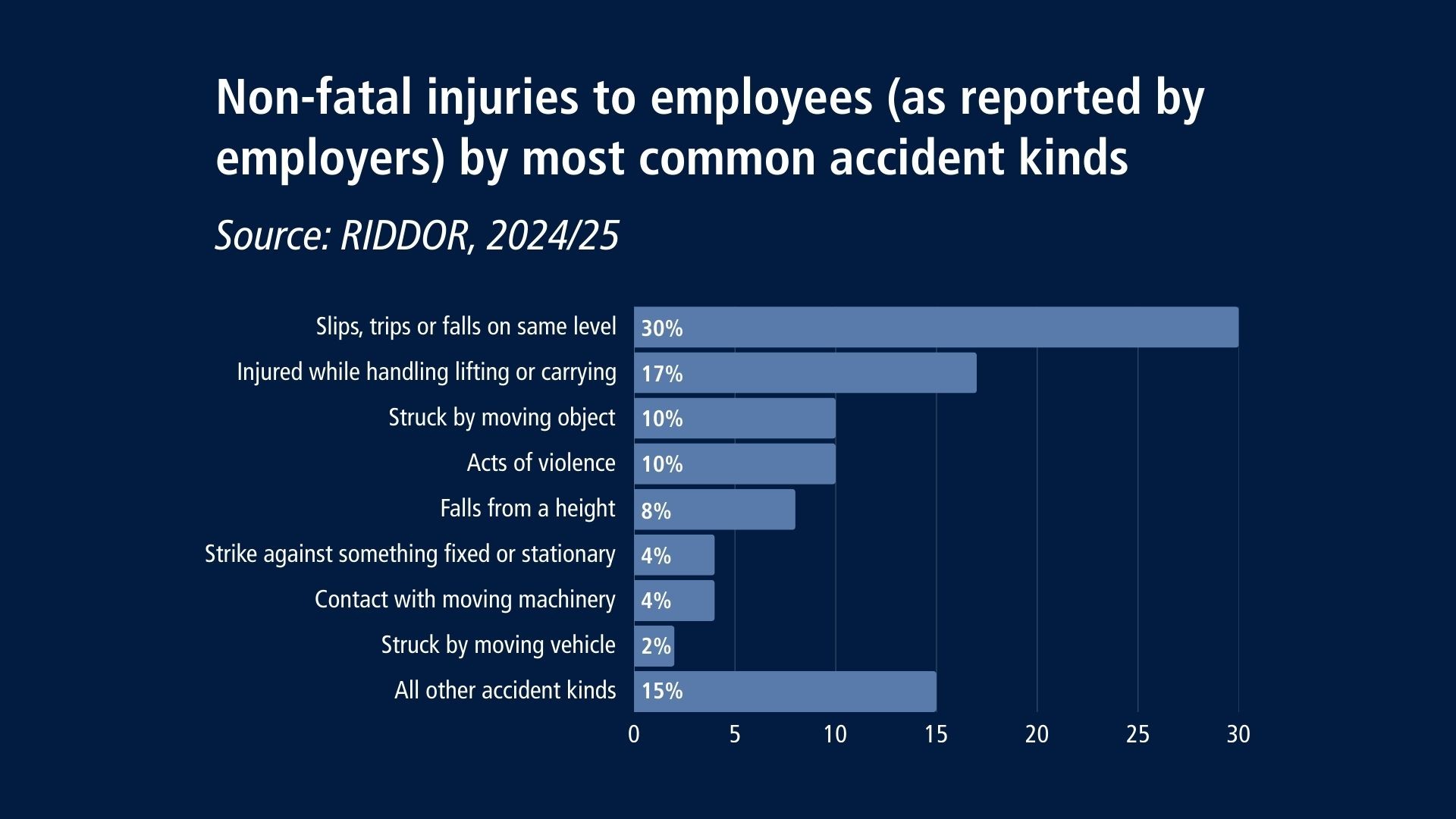
30% of non-fatal workplace injuries are slips, trips or falls on the same level
Despite advances in workplace safety and awareness, slips, trips and falls on the same level remain to be the leading cause of non-fatal workplace injuries in the UK. According to RIDDOR data, these incidents account for 30% of non-fatal workplace injuries reported by employers (2024/25).
Unlike high-profile accidents involving machinery or working at height, slips and trips often occur during everyday tasks, when walking through workspaces or navigating busy environments. There are a range of reasons why these kinds of injury are common, such as wet or uneven floors, trailing cables, or inadequately lit work areas.
What makes slips, trips, and falls particularly concerning is their reach. These injuries affect workers across a broad range of industries, from offices and retail settings to hospitality, healthcare and manufacturing.
Other kinds of non-fatal workplace injuries
The second most common kind of accident to cause non-fatal injuries is being injured while handling, lifting or carrying, which accounts for 17% of employer-reported injuries. These incidents are particularly prevalent in physically demanding roles and industries where manual handling is routine, highlighting the ongoing impact of poor lifting practices, repetitive strain and insufficient mechanical support.
At the opposite end of the scale, injuries caused by being struck by a moving vehicle represent the lowest reported proportion, at 2% of non-fatal workplace injuries. Despite their lower frequency, they remain a major concern in environments such as construction sites, warehouses and transport settings, where vehicles and pedestrians operate in close proximity.
Non-fatal workplace injuries: Regions
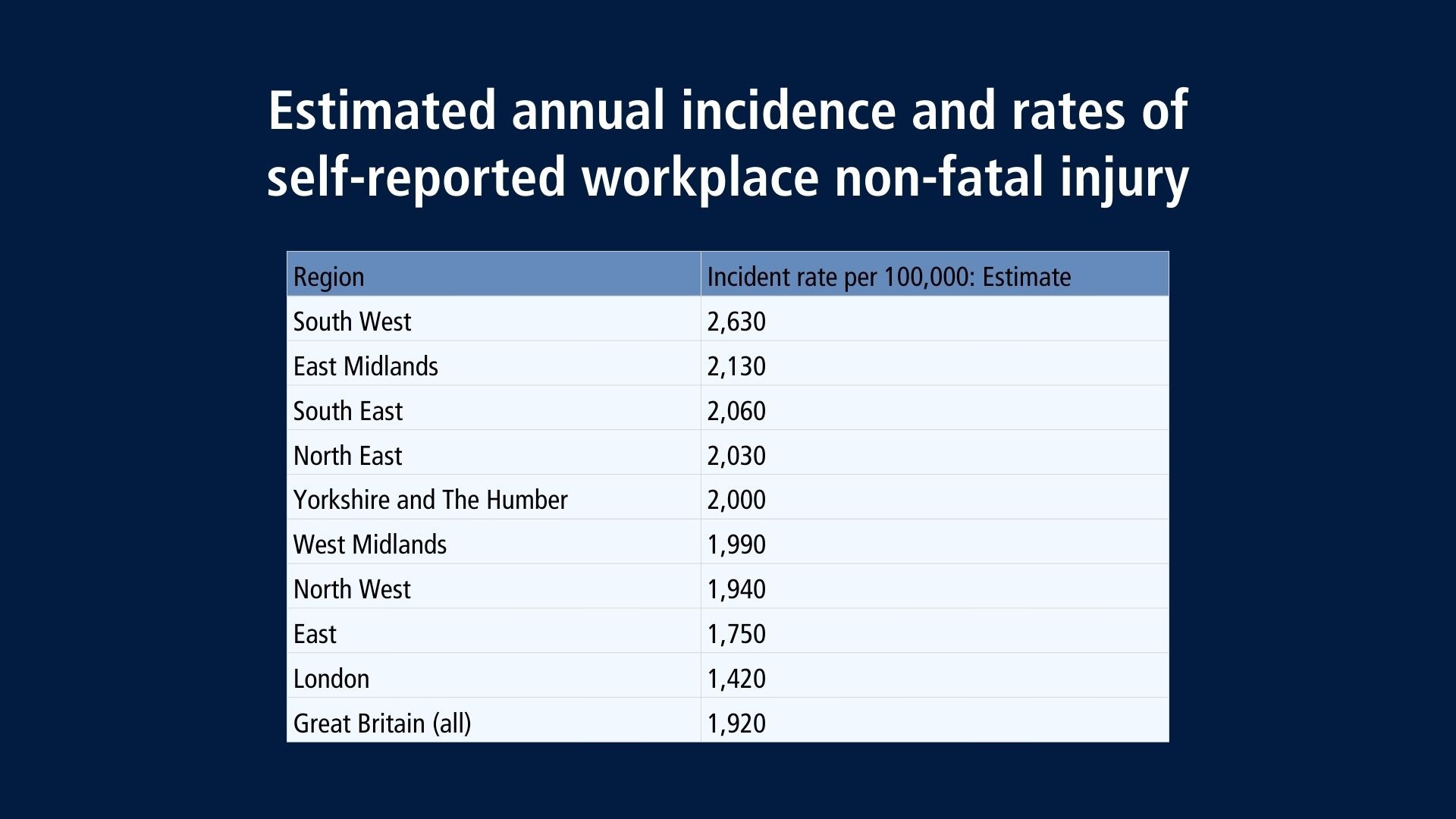
South West has the highest rate of non-fatal workplace injuries
Industries with the highest self-reported non-fatal workplace injuries
1. Accommodation and Food Services
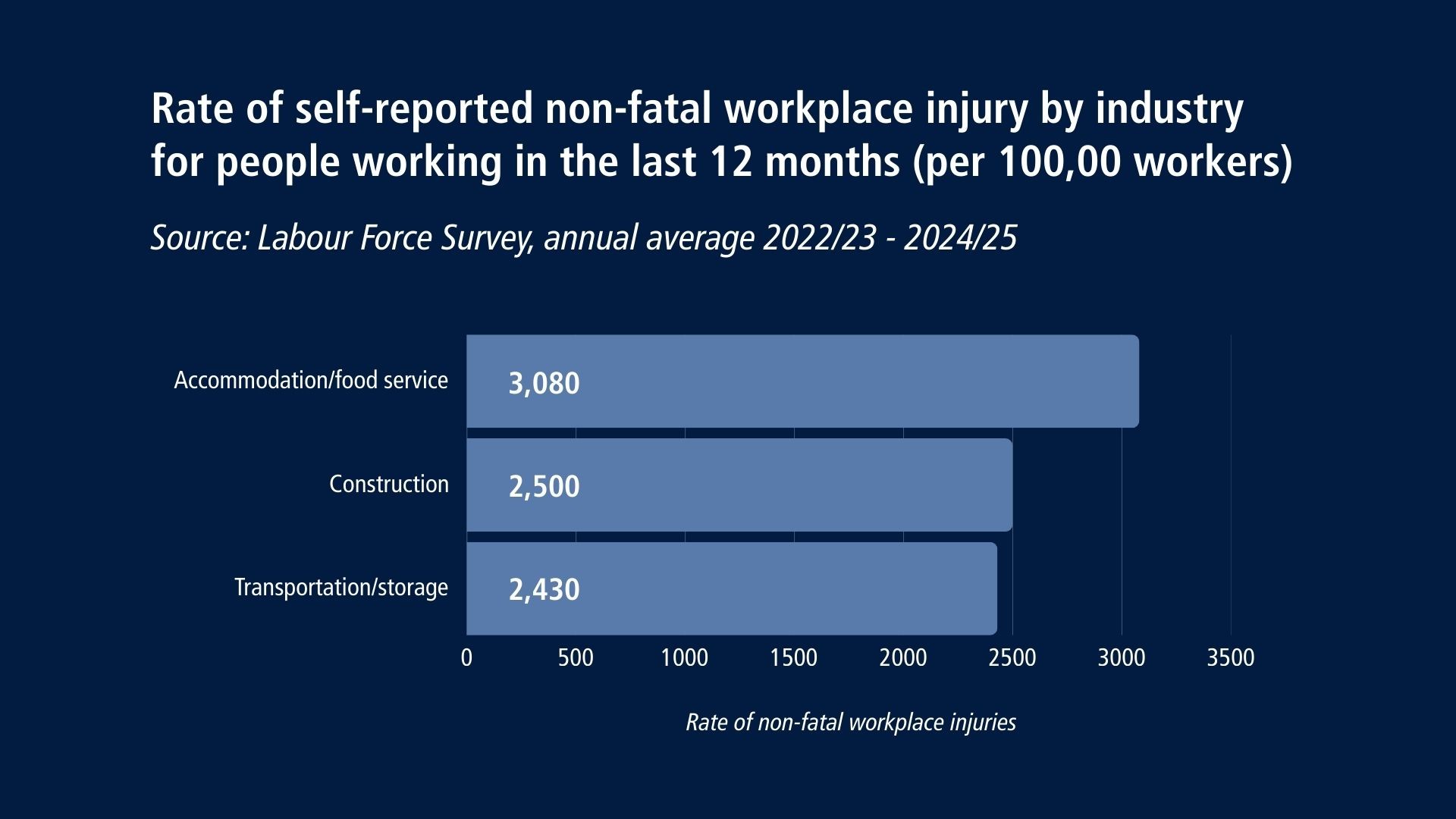
When looking at workplace injuries by industry, the Accommodation and Food Services industry emerges as the industry with the highest rate of self-reported non-fatal injuries. The annual average recorded for 2022/23 - 2024/25, the sector recorded an estimated 3,080 non-fatal workplace injuries per 100,000 workers, a rate that was significantly higher than the average across all industries.
Interestingly, while this sector leads in workplace injuries, it reports one of the lowest rates of work-related ill health, at 2,690 cases per 100,000 workers.
2. Construction
The second highest industry with the most self-reported non-fatal workplace injuries was the Construction industry. Data reported found that around 2,500 self-reported non-fatal workplace injuries per 100,000 workers.
3. Transport and Storage
The third industry on the list was the Transport and Storage industry. Coming just behind the Construction industry, Transport and Storage reported 2,430 self-reported non-fatal workplace injuries per 100,000 workers.
Education: Low workplace injuries, high work-related illnesses
In comparison, while the Education industry reported one of the lowest rates for self-reported workplace injuries per 100,000 workers, it reported one of the highest for self-reported work-related ill health.
For self-reported workplace injuries, the Education industry reported much lower cases than other industries with 1,820 per 100,000 workers. On the other hand, it ranked third highest for work-related illnesses with 4,940 cases behind Human Health and Social Work (5,400) and Public Admin and Defence (5,530).
According to Education statistics in Great Britain (2025), work-related illness significantly contributes to around 3.1 million working days lost each year.
- Work-related illness (93%)
- Workplace injury (7%)
Impact of workplace injuries
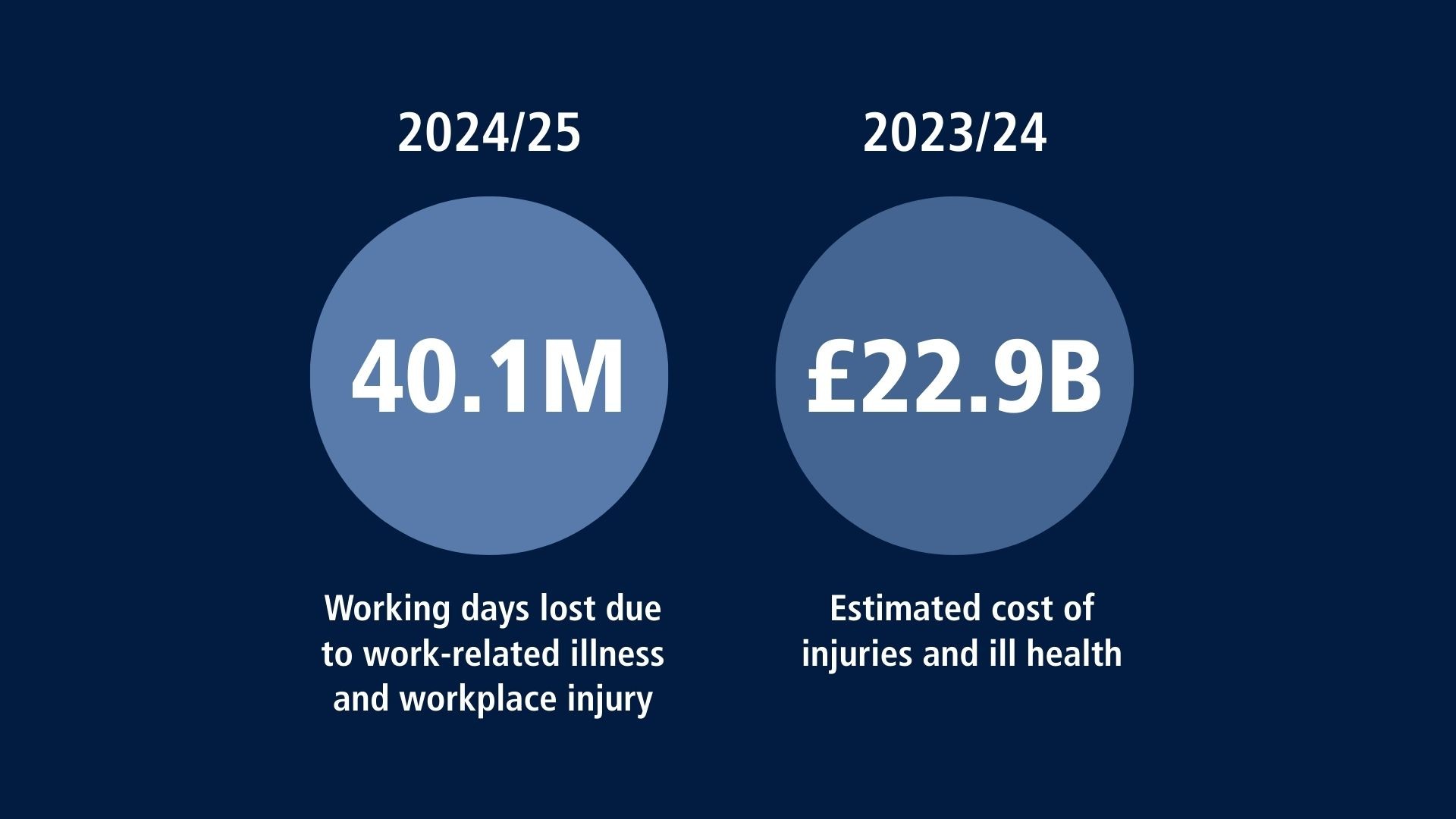
Estimated cost of injuries and ill health: £22.9 billion
Managing Risks at Work
Risk Assessments
Lone Working
“When it comes to worker safety, particularly for lone workers, effective two-way communication can be the difference between preventing a problem arising or having to react to one that might be too late to salvage. Clear lines of voice and data (for example alarm features and text messaging) communication will not only offer greater worker protection, but allows management to effectively manage staff without the need to rely on phone calls that may go unanswered, or constant back-and-forward check-ins on foot that impact efficiency and response time.” - Thomas Bradley, Marketing Manager, Eemits Communications
Creating safer workplaces
Sources
News Archive







10/08/2026




09/04/2026





16/03/2026




19/02/2026


08/01/2026



23/12/2025






18/11/2025








25/09/2025




31/07/2025

31/07/2025

31/07/2025


30/06/2025



30/04/2025

30/04/2025


31/03/2025

26/03/2025






19/02/2025
13/02/2025

13/02/2025

07/02/2025



14/01/2025



17/12/2024
17/12/2024
13/12/2024























31/05/2024

28/05/2024






25/04/2024












05/02/2024

31/01/2024



22/12/2023

22/12/2023




22/11/2023
10/11/2023

27/10/2023

26/10/2023





22/09/2023



31/08/2023




09/05/2023
20/01/2023
23/12/2022
30/11/2022

31/10/2022












28/01/2021

14/09/2020

15/06/2020

22/05/2020

18/12/2019
31/07/2018

20/02/2018








05/10/2017
See What Our Clients Say

“Eemits Communications has been a long-time partner of Whitby Seafoods. Their single-site conventional digital repeater system has driven daily efficiency and given us greater on-site access control. We appreciate their continued commitment to customer satisfaction and look forward to what the future holds.”

"We have a great and longstanding working relationship with Eemits and they have always ticked every box. They offer an excellent, friendly and reliable service.
Eemits have a great understanding of the park and its needs for the customer and our retailers. With a positive can-do attitude, they never say no."

"We started working with Eemits following on from a recommendation from another customer. They provided us with a solution that suits our needs and they continue to supply the best service with no issues.
Eemits is a professional, friendly and reliable company."

"Eemits continue to provide us with a great supportive service consistently being very helpful. The whole team is great and it's very clear the staff have a great knowledge of the products and are happy to pass this on.
Eemits is a great company."

"The service offered by Eemits is second to none, we have a great working relationship with them and the contract we have is good value for money."

"We needed two-way radios for the guys on the test track and something that was scalable. The solution Eemits provided was far superior in comparison to other competitors offerings.
Everything is done in-house and the service and sales department is particularly good. As masters in their field they are extremely knowledgeable."

"Eemits dedicate a lot of time to us as a customer - we feel like we get a personal touch. They're excellent and go above and beyond. They'll put the work in - i.e. training users.
Good quality, good people, good team, all of who are positive about their company. They demonstrate real passion."

"The quality of service that Eemits provides is excellent. The team is very knowledgeable and they offer high quality products. The TRBOCALL solution fitted meets our site requirements and upgrades our technology.
Lone worker function is particularly useful allowing us to monitor our staff ensuring they are safe at all times."

"Eemits Communication is friendly, professional and competitive. They are excellent and their workmanship and knowledge is great.
Eemits attitude sets them apart - no problem is too big"
"Prior to the installation of our current system onsite communications were poor. Eemits Communications offered us guidance and advice on the different technologies available and delivered a highly effective system on time and within our budget. Its success has led to other departments using the system."

"Eemits Communications Ltd have been involved in work at Hartlepool Power Station for over 10 years now. During this time they have installed an Aerial network through our buildings to enable more efficient internal radio communications.
I have found the staff highly professional at all times and willing to provide help whenever they can, I would have no hesitation in recommending this company."

"Having previously worked with Eemits, we knew that we were dealing with a supplier that we could trust and one that could help us to significantly increase the safety of our lone workers with its unique solutions.
The equipment supplied by Eemits is excellent. We have been greatly impressed by the knowledge and skills of their engineers who have carried out the onsite surveys and installation of the system.
Eemits came up with an innovative approach to overcome challenges that we had with installing a system with the structure of our building, and as such, the quality of radio frequency is outstanding."

"The service delivered by Eemits has been excellent and we have developed a very good working relationship over the years.
As a local business to Falck Fire Services they can respond to faults or general requests very quickly - which is very important in our line of work - whereas similar suppliers have a greater response time.
TRBOCALL is an overall platform that has made a massive improvement to our communications in comparison to the analogue system that we had been using for many years. It provides us with many different applications that can be utilised across the business.
Since introducing TRBOCALL we have seen significant improvements related to safety and in our communications itself, which is critical to our operations."